Thad Ryan—Bill Mason·Blake McGrath relationship
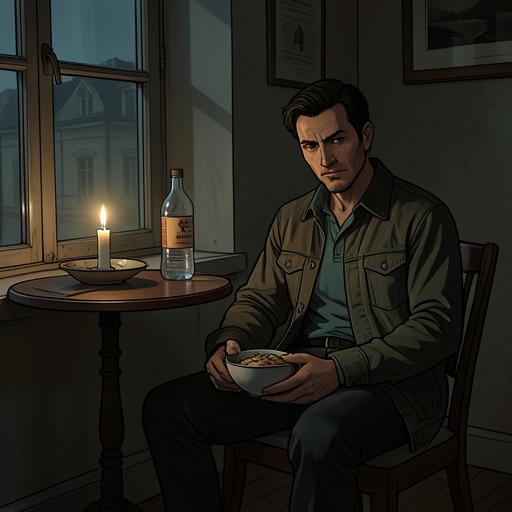
The light house: A love storyThe Thad Ryan—Bill Mason/Blake McGrath relationship begins as a quiet service arrangement and gradually becomes one of the narrative’s most important channels of information. Thad makes weekly deliveries to the secluded Mason property, carrying groceries and other necessities to a man who rarely enters town, has no telephone, and insists on living apart from the community. What appears to be routine local assistance allows the story to establish Bill Mason’s isolation, the strange visibility of his house, and the private grief that governs his life.
Nature and Practical Structure
Thad’s connection to Bill Mason is inherited from his father, Warren Ryan. Warren explains that he had been taking care of Mason’s needs for five years, ever since he first met him, and that the arrangement involved a weekly delivery of groceries and similar household necessities. Mason had given Warren two paintings during the first delivery, but Warren emphasizes that their value to him is sentimental rather than simply commercial. The exchange therefore combines practical care with an unusual personal bond: Mason receives the provisions required for secluded living, while Warren retains objects that carry the memory of their first contact.
The work eventually passes to Thad. Warren tells Connie Dixon that he met Mason only once and that, since then, his son has made the regular weekly deliveries to the Mason property. Thad is thus not presented as an intimate confidant or formal employee, but as the young local intermediary who keeps Mason connected to the material world without forcing him into public life. The arrangement is repetitive, dependable, and deliberately undramatic, precisely because Mason’s existence depends on remaining undisturbed.
Thad as Access to a Closed World
When Connie Dixon wants to locate Mason’s home, Warren introduces her to Thad and explains that she needs directions. Thad immediately warns that Mason may not welcome a visitor. His warning reflects practical knowledge of Mason’s habits rather than hostility toward Connie: the householder is known to value privacy, and an unannounced approach risks violating the terms on which the delivery relationship operates.
The property cannot be reached by telephone contact because Mason has no phone. Thad offers no alternative means of arranging a visit, leaving Connie to take her chances in person. This absence of ordinary communication makes the weekly delivery especially significant. Thad’s arrival is not merely a commercial convenience; it is one of the few regular points at which the secluded man can receive supplies and briefly encounter another person.
Thad also explains the local name for the property: the light house. It is not an actual lighthouse. Every light in the house remains on day and night, so local fishermen can see the building for miles out to sea. The name transforms Mason’s private habit into a landmark, making his isolation paradoxically conspicuous. Although he tries to disappear from public life, the illuminated house broadcasts his presence across the water.
Roses, Conversation, and the Limits of Knowledge
The most distinctive item in Thad’s weekly delivery is not food but seven roses, one for every day of the week. Thad finds this strange because Mason lives alone, yet he cannot explain the flowers’ purpose. The roses introduce an emotional and ritual dimension that exceeds the practical terms of the delivery. To Thad, they are an unexplained eccentricity; to the reader, they become an early sign that Mason’s solitude is organized around remembrance.
Thad does speak with Mason during deliveries, but he cannot provide Connie with the dramatic portrait she expects. Mason is not loud, angry, or rude. Thad describes him as a normal man who simply likes his privacy. This distinction is crucial: the delivery relationship does not confirm that Mason is unstable or threatening. Instead, it shows a person who has withdrawn from ordinary society while remaining capable of polite, limited contact.
Thad’s knowledge remains partial. He has regular access to the property, yet he does not understand the meaning of the roses, the permanently lit rooms, or Mason’s near-total absence from town. Mason may appear to Thad as an ordinary customer, but the pattern of his requests forms a private language that the delivery boy can observe without deciphering. The relationship therefore preserves the mystery rather than solving it.
The Hidden Meaning of the Arrangement
The later revelation that Bill Mason is Blake McGrath recasts Thad’s deliveries. The groceries have been sustaining Blake McGrath’s self-imposed seclusion, while the roses have served his nightly memorial ritual for Chloe. Blake and Ned go to the beach at sunset and send a rose into the sea; Ned then remains on the empty beach through the night, waiting for Chloe. The seven roses Thad delivers are consequently not decorative purchases but supplies for a repeated act of mourning.
The light house also acquires its true meaning. Blake leaves every light on because he wants Chloe to find her way home and return to him. Thad sees the illuminated building as an unexplained local oddity, whereas Blake experiences it as a beacon directed toward the dead. The delivery relationship thus carries the physical materials of Blake’s continuing bond with his daughter without exposing the grief that gives those materials their meaning.
This pattern illustrates the difference between what a community can witness and what it can understand. Thad sees a private man, a strange house, and seven roses. He does not see the drowning that produced the ritual or the imagined adult daughter Blake paints into five seascapes so that Chloe might someday recognize herself and know that she had been remembered and loved. His deliveries sustain a memorial world whose significance is deliberately concealed from ordinary observers.
Boundaries, Care, and Narrative Significance
Thad’s role is defined by respectful distance. He warns Connie about entering the property, accepts that Mason has no phone, and describes him without sensationalism. Even when Connie presses him for details, Thad offers only what he has directly observed. His restraint protects Mason’s privacy and contrasts with Connie’s increasingly urgent desire to uncover the identity behind the hidden paintings.
At the same time, Thad’s recurring visits prevent Mason’s isolation from becoming complete abandonment. Weekly groceries, occasional conversation, and the delivery of roses create a thin but reliable line between the secluded artist and the surrounding town. The relationship is neither friendship in the ordinary sense nor emotional intimacy, yet it performs a form of care. Thad helps maintain the conditions under which Blake can survive his grief until he is able to confront it.
That transition eventually becomes visible in Blake’s final farewell to Chloe. He throws the last red rose into the waves and tells her goodbye, then returns to Connie Dixon. Together they weep, and Connie turns off the lights one by one until the light house is no more. The ending does not erase the years of service represented by Thad’s deliveries; it closes the ritual those deliveries have supported. Once Blake can release the rose and re-enter life, the practical relationship that carried the roses to his door has fulfilled its hidden emotional purpose.